
I didn’t have a name for it then. I just knew something was off. Not in the obvious way – there was no singular moment, no clean break, nothing you could isolate and point to as the problem. Things didn’t fail loudly. They shifted. Quietly, incrementally, almost politely. A rule bent just this once. A plan adjusted to keep things moving. A boundary softened because there was no need to make a fuss. Each change made sense in isolation. Each one was reasonable, temporary, and contained. But the direction was changing, and that was the part that didn’t sit right. Not immediately visible, not measurable in the moment, but present all the same – a subtle deviation from where we said we were, and more importantly, from where we intended to be. I could feel the accumulation before I could explain it.
So I would say something, not loudly, not theatrically, just enough to mark the line. “This is different.” “That’s not what we agreed.” It wasn’t a challenge so much as a checkpoint. But almost every time, the response came back in some variation of the same pattern: it’s just an inch, you’re overthinking it, don’t be so rigid. Always the qualifier – just, only, for now – language designed to compress the moment until resisting it felt disproportionate. And I didn’t yet have the language to explain why it wasn’t. Because I wasn’t reacting to the inch in front of us. I was reacting to what that inch represented when repeated, when normalised, when absorbed into the system as acceptable behaviour.
Even then, I could see that repeated small deviations don’t stay small. They accumulate. They compound. And over time, they produce outcomes for which no single decision appears responsible. Everything looks reasonable in isolation, every adjustment defensible, every exception justified, right up until the point where the result is clearly off and no one can identify exactly when it happened. So I held the line where I could, and that’s where it became uncomfortable. Because pushing back on something small looks like an overreaction. It reads as rigidity, as dogma, as making a problem out of nothing. There’s no visible failure yet, no shared sense of urgency, no immediate consequence to justify the resistance. Just friction, and a quiet but persistent suggestion that maybe you’re the problem.
What took longer to understand is that the disagreement was never about the inch. It was about the model. Most people evaluate locally – is this acceptable right now, in this moment, given the context before us? I was evaluating longitudinally – what does this become if repeated, if compounded, if left uncorrected? They were judging the moment; I was judging the trajectory. Those are not the same question, and they don’t produce the same answers. Once that became clear, the pattern itself made sense. Not just the drift, but the reaction to it. Early correction always feels excessive in a system that hasn’t yet made its deviation visible. There’s no recognition for holding a boundary that hasn’t obviously been crossed, only resistance, negotiation, and the steady pressure to accept just this one.
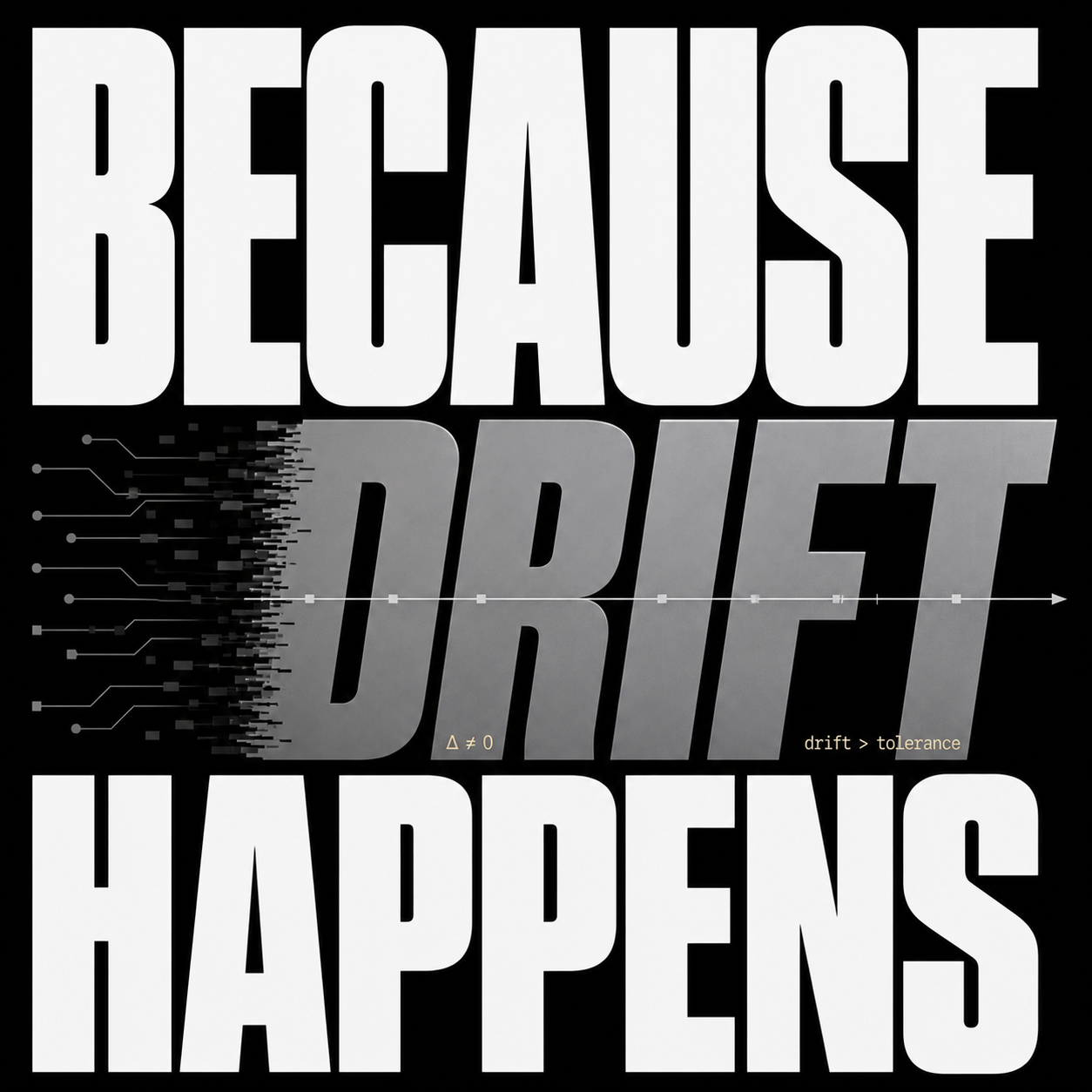
But systems don’t fail because of one decision. They fail because small, uncorrected deviations accumulate beyond tolerance, and by the time that deviation becomes visible, it’s already expensive to fix or impossible. I didn’t have the language for that then, only the instinct. Now the framing is clearer, and it holds across systems, not just situations. Because Drift Happens.
