Most problems with social media are not moral problems.
They are not cultural problems.
They are systems failures.
People do not lose clarity because platforms are evil. They lose clarity because they allow an external system to shape inputs, behaviour, and feedback loops that were never designed in their favour.
The solution is not better content.
It is better control.
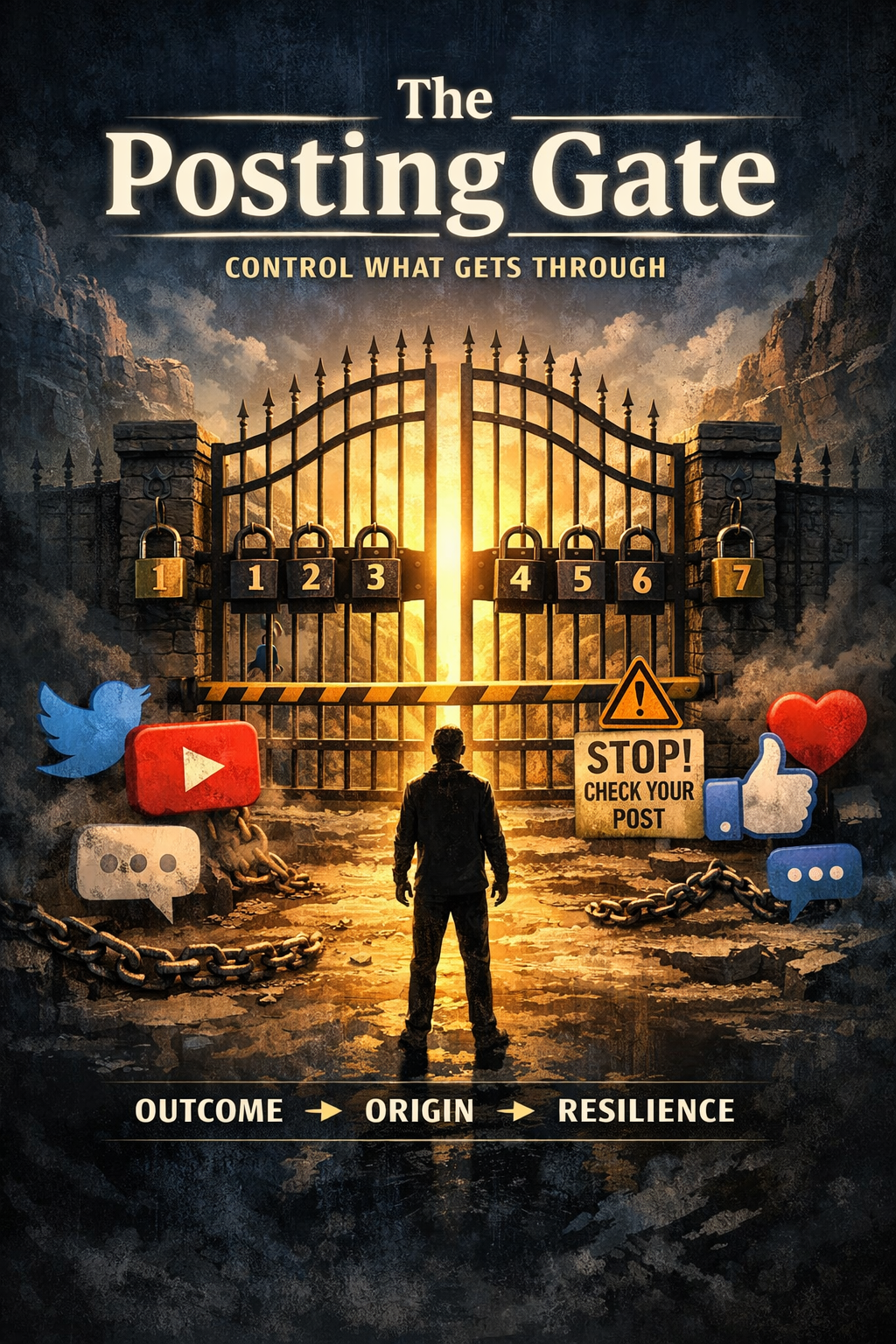
This essay introduces a Posting Gate – a hard decision filter that determines whether something should be published at all – followed by a map of the most common failure patterns that occur when the gate is bypassed.
This is not advice.
It is a control mechanism.
Social media as an untrusted system
Social platforms are untrusted external systems.
They do not optimize for truth, clarity, or expertise. They optimize for attention extraction, behavioural prediction, and engagement velocity. This does not make them malicious. It makes them unsuitable as thinking environments.
The error occurs when operators forget this distinction and allow social media to become:
- A place where ideas are formed
- A source of feedback on quality
- A proxy for authority
- A substitute for owned systems
Once that happens, system drift is inevitable.
The Posting Gate exists to prevent that drift.
The Posting Gate
The Posting Gate is evaluated before anything is published.
If any gate fails, the post does not happen.
No exceptions. No rationalizations.
Gate 1 – Outcome alignment
Every post must serve a defined outcome.
Acceptable outcomes include:
- Reinforcing authority established elsewhere
- Pointing to owned work
- Publishing a finished observation
- Maintaining light signal presence
Unacceptable outcomes include:
- Stimulating discussion
- Testing half-formed ideas
- Seeking validation
- Filling silence
- Reacting emotionally
If the outcome cannot be stated in one sentence, posting stops.
Presence without purpose is noise.
Gate 2 – Origin check
All ideas must originate off-platform.
Acceptable origins:
- Long-form writing
- Private notes
- Real-world work
- Completed thinking
Unacceptable origins:
- Comment threads
- Platform arguments
- Trending topics
- Emotional reactions
If an idea was born on a platform, it stays there.
Platforms are not thinking spaces. They are distribution edges.
Gate 3 – Compression survival
Social media compresses meaning aggressively.
Before posting, assume:
- Context will be lost
- Readers are distracted
- Misinterpretation is likely
If the idea cannot survive compression without clarification or defence, it does not belong in that container.
Ideas that require explanation need a different medium.
Gate 4 – Defensive load
A simple test reveals most bad posts.
If you are already anticipating objections, drafting replies, softening language, or adding disclaimers, the post fails.
Anything that requires defence is not ready for broadcast.
Clarity does not argue.
Gate 5 – Feedback immunity
Engagement metrics are not feedback. They are telemetry.
Before posting, ask:
Would low engagement change my behaviour?
If the answer is yes, posting stops.
A system that self-corrects on corrupted signals will degrade quickly.
Gate 6 – Identity integrity
Every post compounds identity.
Reject anything that:
- Chases relevance
- Mimics platform tone
- Over-explains competence
- Trades precision for reach
If the post would feel embarrassing, diluted, or misaligned six months from now, it fails.
Authority is cumulative, not reactive.
Gate 7 – Exit safety
The final test is brutal and necessary.
If this platform vanished tomorrow, would this post still matter?
If the value only exists inside the platform, it is not worth publishing.
Social media should never be the only container of value.
Gate decision
Only if all gates pass may the post be published.
Most ideas will fail the gate.
That is not a problem.
That is how stability is maintained.
Failure patterns and how systems drift
When the Posting Gate is bypassed, predictable failure patterns emerge. These are not personal flaws. They are structural consequences.
Failure pattern 1 – Presence anxiety
(Gate violated: Outcome alignment)
Posting to “stay visible” slowly replaces posting with intent.
The system fills silence with noise, dilutes authority, and creates dependence on cadence rather than substance.
Correction requires reasserting silence as a valid state.
Failure pattern 2 – Platform-led thinking
(Gate violated: Origin check)
Ideas begin forming in response to threads, trends, and arguments.
Thinking becomes shallow, reactive, and tone-driven. Intellectual sovereignty is lost.
The fix is simple but uncomfortable: move thinking entirely off-platform.
Failure pattern 3 – Defensive posting
(Gate violated: Compression survival)
Posts invite clarification, explanation, and debate.
This creates energy drain, perceived insecurity, and endless justification loops.
The correction is not better replies. It is refusing to clarify publicly.
Failure pattern 4 – Engagement chasing
(Gate violated: Feedback immunity)
Metrics begin shaping tone, frequency, and subject matter.
Behaviour retrains itself around platform reward loops.
At this stage, the platform is no longer a tool. It is a trainer.
The only correction is to disengage entirely from metrics.
Failure pattern 5 – Identity negotiation
(Gate violated: Identity integrity)
The operator begins explaining credentials, softening positions, and seeking agreement.
Authority erodes quietly.
The correction is to state positions and allow disagreement without response.
Failure pattern 6 – Platform lock-in
(Gate violated: Exit safety)
Content exists only as posts. Followers feel owned. Stepping away feels costly.
This is dependency masquerading as an audience.
The correction is to anchor all value in owned systems and treat posts as disposable wrappers.
Meta-failure – Feedback replaces intention
All failure patterns ultimately trace back to a single root cause.
When:
- Metrics guide thinking
- Comments shape tone
- Visibility becomes the goal
The system has inverted.
At that point, stopping entirely is healthier than optimizing further.
Closing control principle
Social media does not reward good systems.
It rewards reactive ones.
The Posting Gate exists to ensure:
- Intention precedes action
- Authority precedes visibility
- Signal precedes noise
Most posts should never be written.
Most silence is strategic.
Most platforms are optional.
A stable system says no far more often than yes.
#StayFrosty!
~ James
