
Introduction: The Coming Power Shift
For most of the digital age, business owners have been told a simple story: centralize, streamline, and outsource as much of your technology as possible. Hand over your data to cloud platforms. Use single-vendor suites for everything from email to invoicing. Build your business on someone else’s infrastructure, because it’s easier, faster, and “good enough.”
And for a while, that story made sense. Centralized platforms gave small businesses access to world-class tools without the upfront costs. But something has shifted. The same systems that once empowered entrepreneurs now quietly limit them. Vendor lock-in, rising subscription fees, opaque data policies, and geopolitical uncertainty have all changed the equation.
The result is a growing tension: on one hand, the convenience of centralization is undeniable. On the other, the cost of dependency is becoming impossible to ignore.
Enter federation – an old idea whose time has come again. Federation is about linking independent systems together under common standards so they can cooperate without surrendering control. It’s the difference between building on rented land and owning the soil beneath your feet. And in an era when autonomy and adaptability are the keys to survival, it’s a concept every solo entrepreneur and small business owner should understand.
Part 1: What Federation Actually Means
At its core, federation is the opposite of centralization. Instead of relying on one monolithic system to do everything, federation connects many independent systems so they can work together. Each node in a federated network maintains control over its own data, policies, and infrastructure – but agrees to follow shared protocols so collaboration is possible.
You’re already using federated systems, even if you don’t realize it. Email, for example, is one of the most successful federated technologies in history. Anyone can run a mail server and still communicate with Gmail, Outlook, or Yahoo. The Domain Name System (DNS), which translates website names into IP addresses, is another federated structure. No single company controls it, yet it holds the entire internet together.
Federation is less about a specific technology and more about an architectural philosophy. It shows up in many areas:
- Identity federation lets users log into different services using the same credentials.
- Data federation lets you query information stored across multiple databases as if it were one.
- Federated learning allows organizations to train AI models collaboratively without sharing raw data.
- Federated communication protocols like ActivityPub or Matrix enable cross-platform messaging and social networking.
The principle is always the same: shared standards without shared control.
Part 2: Why Federation Is Back in Focus
For much of the past decade, centralization seemed inevitable. The rise of massive cloud platforms like AWS, Google Cloud, and Microsoft Azure reinforced the idea that economies of scale were unbeatable. But cracks are now visible in that narrative, and they’re widening fast.
Here’s why federation is making a comeback:
- Data sovereignty and regulation: Governments are imposing stricter rules on how and where data can be stored. Federation allows companies to comply without handing everything to a single provider.
- Vendor lock-in fatigue: Businesses that once embraced all-in-one platforms now find themselves trapped by rising costs, changing terms, and slow innovation. Federation offers a way to escape that gravity well.
- Security and resilience: Centralized platforms are attractive targets. Federation distributes risk. If one node is compromised, the rest remain unaffected.
- Interoperability mandates: Regulations like the EU’s Digital Markets Act are forcing large platforms to open up. Federation is often the most practical way to comply.
- AI and privacy pressures: As artificial intelligence becomes more integral to operations, businesses need ways to collaborate without exposing sensitive data. Federated approaches make that possible.
The shift isn’t just technical. It’s strategic. Federation allows small businesses to own their infrastructure destiny again – to decide where their data lives, how it’s used, and who gets access.
Part 3: Federation in Practice – Key Applications
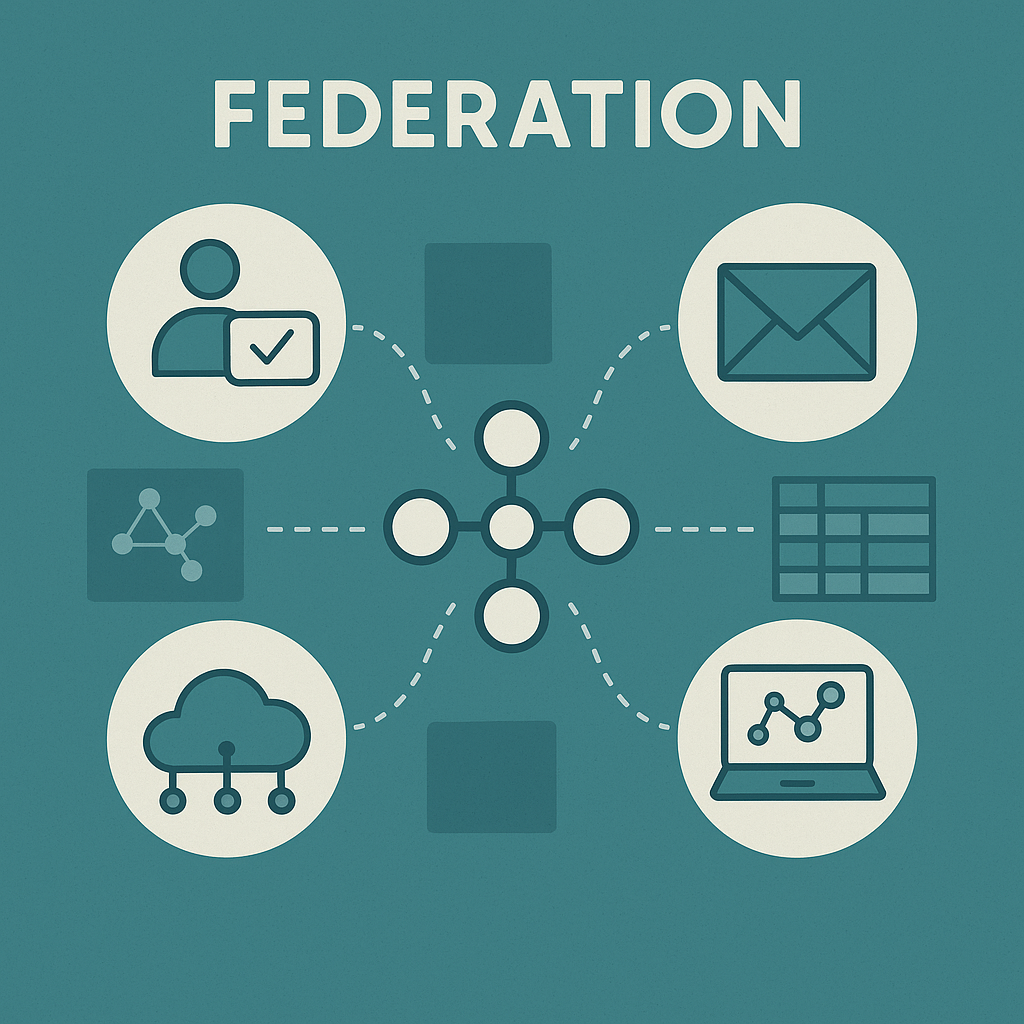
Let’s look at four key areas where federation is already transforming how businesses operate.
1. Federated Identity: Simplify Access, Strengthen Control
Managing logins across multiple services is a nightmare for users and administrators alike. Federated identity solves that problem. Instead of creating separate accounts for each platform, users authenticate once with a trusted Identity Provider (IdP), and other services accept that identity.
For example, a company might use Keycloak or Azure AD as its IdP. Employees log in once, and that authentication grants them access to dozens of internal and external tools without additional passwords.
Why it matters for SMBs:
- Easier onboarding and offboarding of staff.
- Centralized control over security policies.
- Reduced password sprawl and attack surface.
Strategic insight: Identity is one of the few layers of your stack that should never be outsourced blindly. Federation lets you integrate with third-party services while still owning your core user directory and policies.
2. Data Federation: Break Down Silos Without Migration
Data is often scattered across multiple systems – accounting software, CRMs, analytics tools, and custom databases. Traditionally, the solution was painful: consolidate everything into one warehouse. But federation offers a smarter alternative.
With a data federation layer, you can query multiple sources simultaneously and receive unified results. Tools like Trino, Presto, or even federated SQL queries in cloud platforms make this possible.
Why it matters for SMBs:
- Access all your data without expensive migration projects.
- Keep sensitive datasets in place while still leveraging them.
- Gain real-time insights without duplication or ETL overhead.
Strategic insight: In a federated data strategy, your information remains sovereign. You can move it, share it, or revoke access on your terms.
3. Federated Communication: Freedom from Walled Gardens
Centralized communication platforms (think Slack, Teams, or Zoom) offer convenience but lock you into their ecosystems. Federation flips that dynamic. Protocols like Matrix (for messaging) and ActivityPub (for social networking) allow independent servers to talk to each other seamlessly.
This model mirrors how email works: you can run your own server or join a hosted one, yet still communicate across the network.
Why it matters for SMBs:
- Own your communication history and policies.
- Avoid platform lock-in while preserving collaboration.
- Integrate messaging deeply into your workflows.
Strategic insight: Federated communication is part of digital sovereignty. It ensures no single company can cut off your team or clients from critical conversations.
4. Federated Machine Learning: Collaborate Without Compromise
As AI becomes a competitive advantage, many organizations face a dilemma: how to leverage machine learning without sharing sensitive data. Federated learning is the answer. Instead of centralizing data, each participant trains a local model, and only the updates (not the raw data) are shared and aggregated.
Why it matters for SMBs:
- Participate in industry-wide AI initiatives without exposing customer data.
- Comply with privacy laws while still benefiting from collective intelligence.
- Unlock new product features based on private, distributed datasets.
Strategic insight: In the coming AI-driven economy, federated learning could become as fundamental as HTTPS or email – a way to collaborate safely across boundaries.
Part 4: Federation as a Strategic Lever
For solo entrepreneurs and small business owners, federation isn’t just a technical concept. It’s a strategic mindset shift.
The more you rely on centralized platforms, the more vulnerable your business becomes to forces beyond your control – policy changes, pricing hikes, service outages, or even political decisions. Federation offers a different path: one where you remain the primary decision-maker over how your digital ecosystem operates.
Think of it this way:
- Centralization is like renting an apartment in someone else’s building.
- Federation is like building a home on your own land but connecting it to shared infrastructure like roads, water, and electricity.
The first is convenient but temporary. The second requires more responsibility but gives you far greater freedom.
Part 5: The Business Case for Federation
Let’s make this even more practical. Here’s what a federated strategy can deliver for small businesses:
- Cost Predictability: Self-hosting or using open federated systems can significantly reduce recurring SaaS costs over time.
- Negotiating Power: When you’re not locked into a single vendor, you have leverage.
- Compliance Confidence: Federation helps you meet data residency, privacy, and regulatory requirements without costly audits.
- Customer Trust: Owning your data and infrastructure signals professionalism and commitment to security.
- Scalable Future-Proofing: As your needs evolve, federation lets you swap components without disrupting everything else.
The early investment in learning and setup pays long-term dividends in flexibility, control, and resilience.
Part 6: Commanding the Machines
The phrase “command the machines” is not about rejecting technology. It’s about mastering it – using it deliberately and strategically rather than becoming dependent on it. Federation embodies that philosophy.
It’s about deciding which systems you control outright and which ones you choose to integrate with. It’s about building your business on protocols, not platforms. And it’s about designing an ecosystem that can grow, evolve, and pivot as quickly as you do.
Here’s the truth: The digital world is moving toward more interoperability, not less. Regulators, consumers, and even large enterprises are demanding openness and accountability. Businesses that understand and embrace federation now will be the ones best positioned to adapt to this new landscape.
Final Thoughts: The Future Belongs to the Federated
Centralized platforms will always have their place, and not every system needs to be federated. But the era of blind trust in monolithic vendors is over. The next decade will belong to those who balance the convenience of the cloud with the sovereignty of federation.
For solo entrepreneurs and small businesses, this shift represents more than just a technical opportunity. It’s a chance to take back control – of your data, your costs, your customer relationships, and ultimately, your future.
Because when you federate, you stop renting your digital destiny. You start owning it.
And that’s what it truly means to command the machines.
StayFrosty!
~ James
