
Strangling the Monolith: Modernizing Legacy Code Without Losing Your Mind
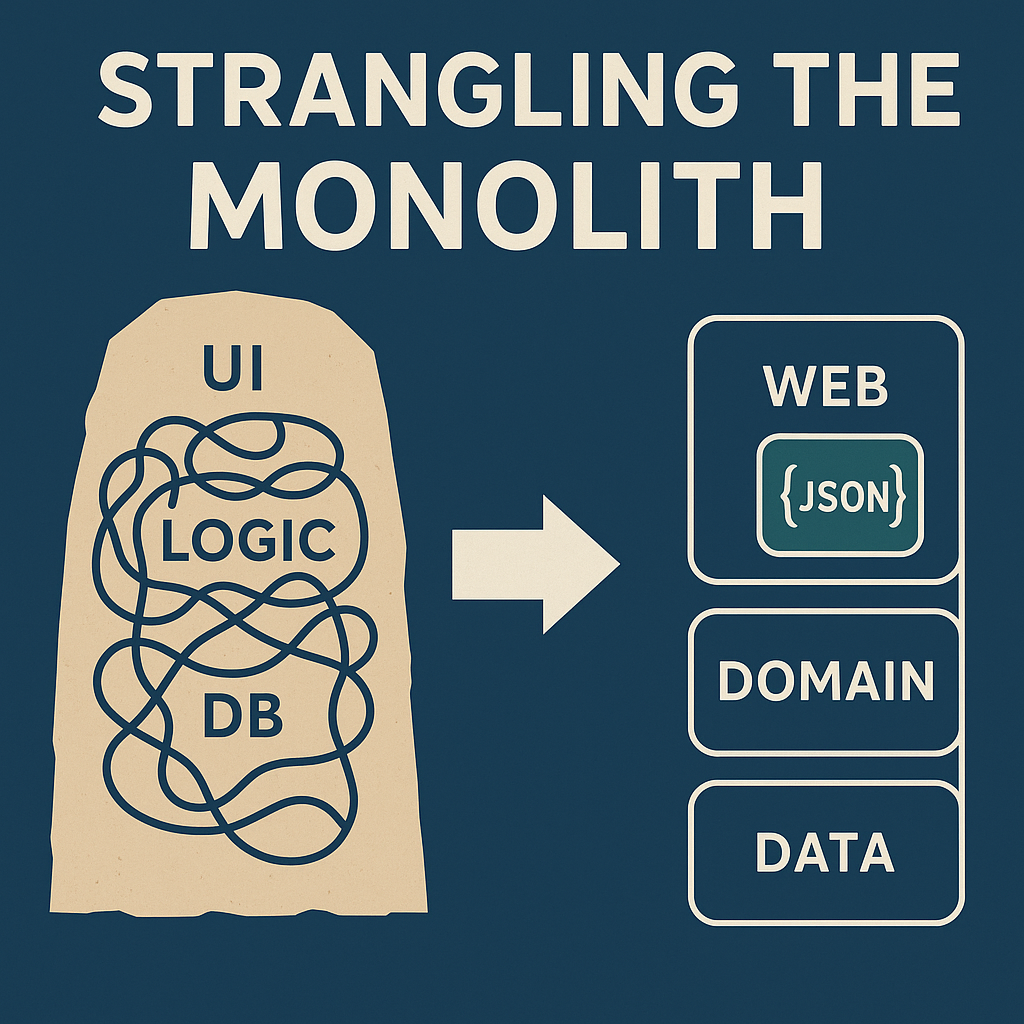
Software has a long memory. What began as a tidy project years ago often grows into a sprawling organism—a monolith where user interface, business rules, and database access are mashed into the same files. These systems still work (sometimes miraculously), but they are brittle, hard to change, and intimidating to touch. Everyone knows the codebase needs modernization, but few dare to swing the wrecking ball.
A full rewrite is tempting, but history is clear: big-bang rewrites are usually expensive failures. The safer path is gradual transformation, carving clean seams into the mess while keeping the lights on. This essay is about how to do exactly that:
modernize a monolith from the inside out, step by step, without breaking your business.
Why Monoliths Are Hard to Change
When developers describe “legacy” code, they usually mean tight coupling. Presentation logic (HTML, CSS, JavaScript) lives side-by-side with SQL queries and domain rules.
Change one thing and you risk breaking three others. Testing is painful because functions reach into the database, render templates, and send emails all in one go.
These systems also resist scaling:
- You cannot introduce new frameworks or languages without ripping apart everything.
- You cannot isolate performance bottlenecks.
- You cannot replace a database or UI library without rewriting large swaths of code.
It’s not the monolith shape that kills you. It’s the big ball of mud—an architecture with no boundaries, where all concerns bleed together.
Principles for Modernization
Before diving into tactics, some guiding principles keep you sane:
- Don’t rewrite from scratch. The business relies on this system. A greenfield replacement almost always overruns schedule and budget.
- Create seams, not fractures. A seam is a place where you can change code without changing behaviour. You intentionally build seams, then exploit them.
- Work in vertical slices. Transform one feature end-to-end, not one layer across the whole system.
- Preserve the outside contract. Users shouldn’t notice (at first). Keep URLs, inputs, and outputs consistent.
- Observe relentlessly. Without logging, metrics, and tests, you’re refactoring blind.
- Move I/O to the edges. Pure logic in the middle, side effects at the boundaries.
These are the same principles behind Fowler’s Strangler Fig Pattern: grow the new system around the old, until the old is no longer needed.
Step 1: Freeze Behaviour With Tests
Before pulling threads, you need a safety net.
- Characterization tests: Write tests that assert current behaviour, even if it looks wrong. The point isn’t correctness, it’s change detection. If you modify code and a test breaks, you know you altered behaviour.
- Golden path recordings: Capture real HTTP requests and responses. Re-run them after refactoring. If the JSON or HTML changes unintentionally, you caught a regression.
- Log first, then test: If adding tests seems impossible, start by adding structured logs. They’ll give you enough visibility to fake it until better tests exist.
Think of this as putting the monolith in a glass box—you can poke it safely without breaking the ecosystem inside.
Step 2: Introduce a Facade
A facade is a new entry point that wraps the old one. Instead of calling legacy code directly, you go through the facade.
Two common facades:
- HTTP/JSON seam: Add an Accept: application/json mode to existing endpoints. The old HTML view continues to work, but now you can build modern clients against clean JSON.
- Function-level seam: Create a single interface file that legacy controllers must call. The old logic still runs, but now you have one hook point for redirection.
This is the beginning of the Strangler Facade Pattern. The old monolith is still alive, but you’re creating a new layer that will eventually own all traffic.
Step 3: Carve Out Concerns
Inside the monolith, start separating responsibilities.
- Data Access: Extract raw SQL calls into a repository module. Even if the queries are ugly, at least now they’re in one place.
- Business Logic: Wrap rules into pure functions that take plain data and return plain results. Avoid side effects inside these functions.
- Presentation: Pull HTML or templating code into view files. Keep business logic out.
The goal is not to achieve perfection right away, but to start untangling the knot one strand at a time.
Step 4: Move I/O to the Edges
The single best way to make a codebase testable is to shove side effects outward.
- Database: Go through a repository layer. Even if the repository is a thin pass-through, you can later swap in mocks, caches, or new databases.
- External APIs: Wrap them in gateway classes. That way you can test the core without making live API calls.
- Email, files, sockets: Funnel them through adapters. They don’t belong in your business logic.
When you can run core business rules entirely in memory, you’ve freed yourself from the worst legacy traps.
Step 5: Peel Off Vertical Slices
Pick one small feature. For example, “user can update their profile picture.”
Take that feature through the new pipeline:
- Request hits the facade.
- Facade calls new domain logic.
- Domain logic uses repository and gateway adapters.
- Response is rendered by either the new UI or legacy HTML.
Users shouldn’t notice the difference. Under the hood, though, you’ve carved out a clean slice that bypasses the monolith.
Repeat this process, one feature at a time. Eventually, the old paths have zero traffic, and you can delete them.
Step 6: Upgrade the Runtime
At some point, you’ll want to escape old frameworks or languages.
- Compatibility shims: Run both runtimes side-by-side, bridging with APIs or sockets.
- Side-by-side execution: Deploy legacy and new apps behind the same reverse proxy. Route traffic by URL or feature flag.
- Dual-stack deployment: For a while, you may run Python 2.7 and Python 3, or PHP 5 and PHP 8, in the same system. The key is to hide this behind the facade.
Never cut everything over at once. Use feature flags to control rollout.
Step 7: Tame the Database
Databases are often the hardest part of legacy systems. Tables are messy, constraints are absent, and queries are scattered.
Modernization tactics:
- Read first: Introduce a new read-only data access path through repositories. The monolith still writes, but new code can read safely.
- Dual writes: For a while, both old and new code write to the same table. Or you mirror into a new schema.
- Add constraints gradually: As you learn the true rules, add NOT NULL, foreign keys, and check constraints. Let the DB enforce sanity.
Over time, you can build a clean domain model on top of the old schema, and eventually migrate tables.
Step 8: Automate Everything
Refactoring without automation is begging for pain.
- CI/CD pipelines: Run tests and linters on every commit. Break builds on regression.
- Golden request replays: Record and replay production traffic against a staging environment. Diff the results.
- Code analysis: Static analyzers can point out dead code, complexity, and duplication.
- Usage metrics: Log which endpoints, queries, and templates are still hit. Dead code removal becomes data-driven.
The less you trust humans to check everything, the safer you’ll be.
Step 9: Delete Dead Code Aggressively
The final step of modernization is also the most cathartic: deletion.
If logs show no traffic to a path for a full release cycle, remove it. The business won’t miss it. Every line deleted is one less line to maintain.
Deletion is how you measure progress. Refactoring isn’t about new code—it’s about shrinking the legacy system until it disappears.
Common Pitfalls
- Microservices too early: Splitting into services won’t save you if each service is still a mess. Clean inside the monolith first.
- Big bang rewrites: You’ll never ship before the business changes again. Strangler patterns keep you aligned.
- Unobserved refactors: If you don’t have tests and logs, you can’t know what you broke.
- Leaky abstractions: If your new domain code knows about table names or HTML fragments, you’re still tangled.
Modernization fails when it’s treated as a one-off project. It succeeds when it becomes a continuous way of working.
Case Study: The JSON Seam
One of the simplest modernization moves is to add a JSON output option.
Suppose your legacy system renders HTML via Python 2.7 CGI scripts. By adding an Accept: application/json branch, you can return structured data for the same endpoint.
The benefits are enormous:
- You can build a React or mobile app against the JSON, while legacy HTML still works.
- You can write automated tests that compare JSON output across versions.
- You’ve created a seam: one place where you can redirect traffic to new code without breaking the old.
Many modernization journeys start here. It’s cheap, low-risk, and opens the door to full API-first design.
A Pragmatic Sequence
Here’s a practical order of operations:
- Add logging and basic tests.
- Introduce a facade layer.
- Wrap DB calls in a repository.
- Add JSON responses.
- Rewrite one feature end-to-end.
- Use feature flags for rollout.
- Clean up database constraints.
- Automate builds and golden request tests.
- Delete unused legacy code.
This sequence works because it balances safety and momentum. You’re delivering visible progress early, while never putting the whole business at risk.
The Bigger Picture
Modernization is not just about code. It’s about trust. Legacy systems linger because people fear breaking them. By adding seams, tests, and visibility, you give the team courage to make changes.
It’s also about discipline. A monolith becomes a ball of mud because shortcuts accumulate faster than refactors. Modernization succeeds only if the team commits to cleaner practices going forward—otherwise today’s “new” code becomes tomorrow’s mess.
And finally, it’s about value. The purpose of modernization is not elegance for its own sake. It’s enabling new business features, improving developer velocity, and reducing operational risk.
Conclusion
Modernizing a monolith isn’t glamorous. It’s patient gardening—cutting away weeds, staking up branches, and gradually reshaping the system. But it works. By carving seams, moving I/O to the edges, peeling off slices, and strangling the old code, you can bring a legacy system into the present without ever shutting the business down.
The paradox of modernization is this: the best way to save a system is not to rewrite it, but to grow around it until it quietly disappears.
That’s how you strangle a monolith without losing your mind.
#StayFrosty!
~ James