
Modernizing Legacy: How Containers Bridge the Gap Between Old Systems and Emerging Tech
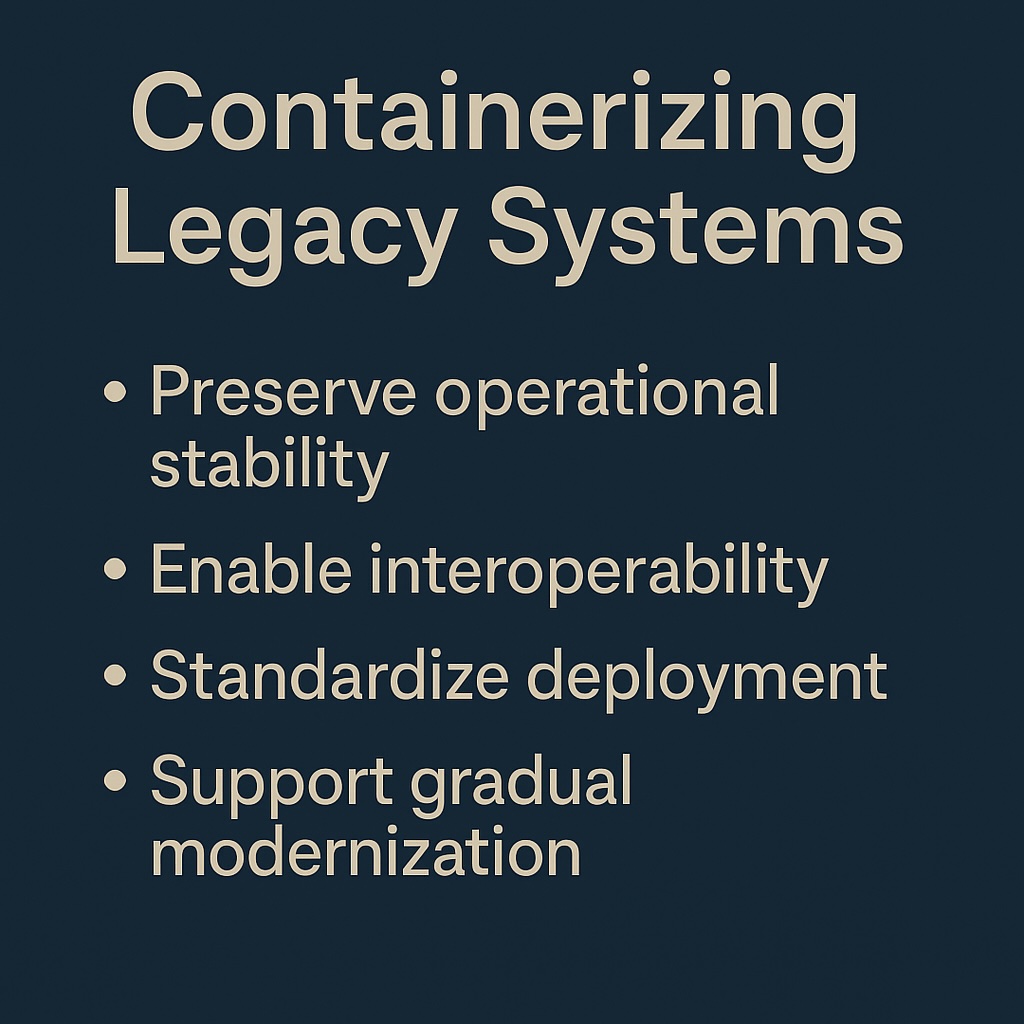
If you’re a senior decision-maker in tech or operations, chances are you’re dealing with the same problem I keep hearing about from other execs: your legacy system still runs the business, but it’s holding you back.
It works—mostly. It’s stable—kind of. But trying to connect it to modern systems, APIs, or AI engines? Forget it.
You know you need to modernize. You also know that ripping everything out and starting over is a high-risk, high-cost move that may not even be politically possible.
There is a better way.
Don’t Rewrite—Wrap
The smartest move isn’t a rewrite. It’s a wrap.
Containerization lets you isolate your legacy system in a controlled environment, effectively preserving what works while making it compatible with what’s next.
This isn’t a gimmick. It’s a strategic modernization layer—one that allows old and new technologies to coexist without conflict.
Think of it like giving your legacy software a protective shell. Now, it can breathe clean air, speak the language of modern systems, and operate safely without contaminating or conflicting with newer infrastructure.
Why This Makes Strategic Sense
Let’s break down what you actually gain from containerizing legacy apps:
1. Risk Containment
Legacy systems are often delicate. Docker lets you lock in the exact environment they need—OS, dependencies, configs—so nothing breaks as you evolve the surrounding tech.
2. Environment Consistency
Run the same container in dev, test, staging, and production. Say goodbye to “it works on my machine.”
3. Cross-Ecosystem Compatibility
You can bridge across platforms, cloud providers, and even on-prem setups without major rewrites.
4. Future-Ready Architecture
Want to add AI or automation? Containerization makes it possible without tearing into legacy code.
5. Speed of Deployment
Spin up new containers instantly. Roll back just as fast. Updates, tests, and rollouts become far more agile.
⸻
Real-World Example: Legacy CRM Meets AI
Let’s say you’re running an old CRM that was built in 2008. It’s running on a specific version of PHP, uses an outdated database, and lives on a server that nobody wants to touch.
You know the data inside it is gold—years of customer interactions, notes, and patterns. But there’s no API, no easy way to extract insights, and every integration feels like surgery.
Instead of rewriting it:
- Step 1: You containerize the CRM, replicating its known-good environment.
- Step 2: You expose controlled endpoints from the container to allow secure data queries.
- Step 3: You deploy an external AI assistant (like a natural language Q&A bot) that interfaces with the CRM data and gives your team modern access to legacy insights.
Now your salespeople can ask things like, “Which accounts haven’t been touched in 90 days?” or “What product do customers in Ontario ask about most?”
All without rewriting the CRM. That’s the power of containerized augmentation.
⸻
Myth vs. Reality
- ❌ Myth: “Our system is too old to containerize.”
- ✅ Reality: As long as it can run on a known OS, it can be containerized—even if that means using an older base image and extra care during setup.
⸻
- ❌ Myth: “Containerization means putting everything in the cloud.”
- ✅ Reality: Containers can run on-prem, in the cloud, or in hybrid setups. You choose the deployment model that fits.
⸻
- ❌ Myth: “This will cost as much as a full rewrite.”
- ✅ Reality: It’s not even close. Containerization is dramatically cheaper and faster than rewriting—and comes with far less risk.
⸻
Checklist: Is Your Legacy System a Candidate for Containerization?
Ask yourself:
- ✅ Does the system run on a defined OS and stack?
- ✅ Is it stable in its current environment but hard to scale or maintain?
- ✅ Is it blocking integration with AI or other modern tools?
- ✅ Would isolating it reduce security or performance risks?
- ✅ Are you unable to modify it due to vendor lock-in or lack of in-house knowledge?
If you said “yes” to 3 or more of these, containerization is likely a viable modernization path.
⸻
The Bridge, Not the Burden
The mistake many companies make is waiting too long to modernize because they assume it has to be all or nothing.
But you don’t need to flip the whole table to make progress.
Containerization offers a safe, strategic bridge between where you are and where you want to be. It lets you extract value from existing systems while layering in modern capabilities like AI, automation, and advanced analytics.
The result? Your legacy stack becomes an asset again—not a liability.
#StayFrosty!