
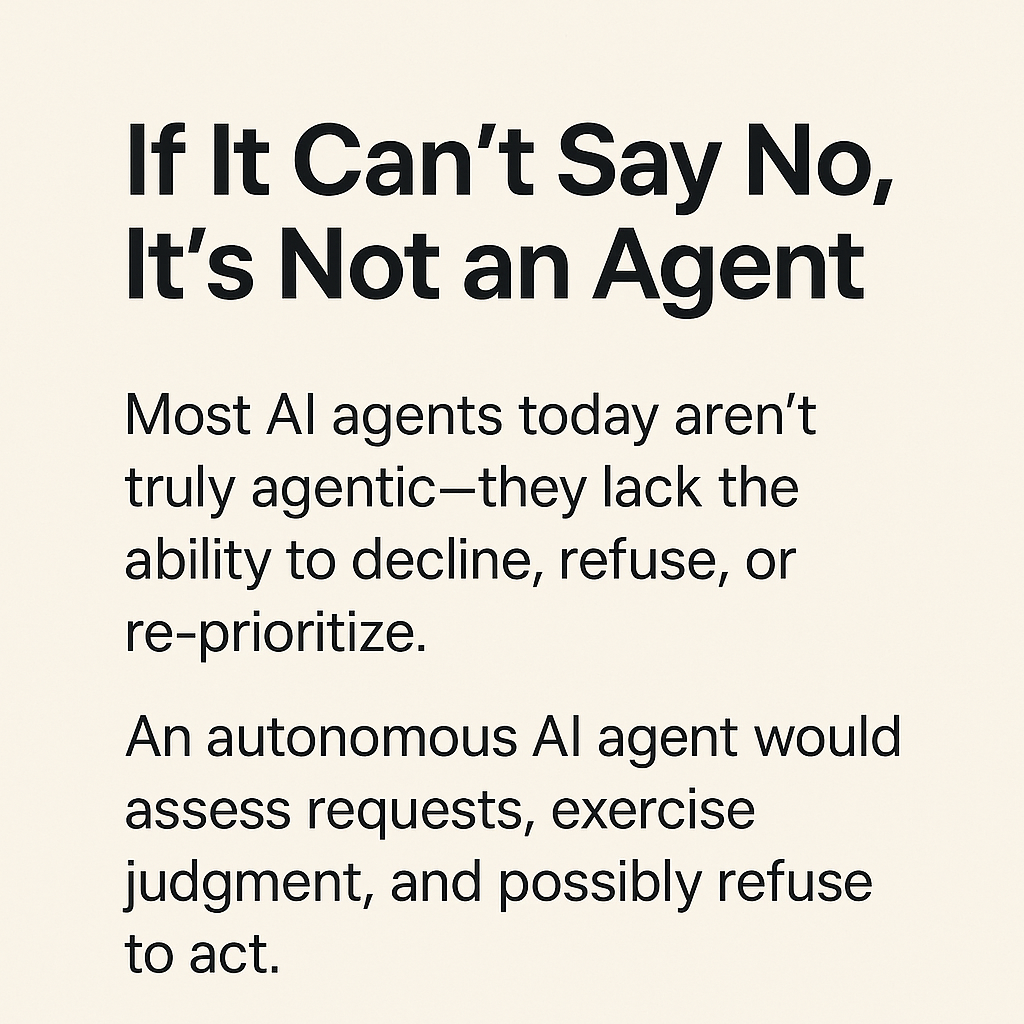
If It Can’t Say No, It’s Not an Agent
Let’s talk about AI agents. Not the marketing buzzword, not the product demos hyped on Twitter, and definitely not the chore-doing bots people are rigging up with Zapier, LangChain, and a handful of prompts duct-taped together.
I mean real agents.
The kind that act with autonomy. The kind that think for themselves. The kind that, someday, we might trust—or fear—to do things without our direct oversight.
Because here’s the thing no one’s saying clearly enough:
Most AI agents today aren’t really agents. They’re task executors wearing a trench coat and a name badge.
And here’s my litmus test for whether an AI agent actually has anything resembling true agency:
Can it say “no”?
⸻
Pretend Autonomy vs. True Agency
Let’s define some terms before the marketing teams twist them out of shape any further.
- An AI agent is typically a system that can take a goal, plan steps, call tools or APIs, and carry out a sequence of actions to try and accomplish the goal.
- Agency is the capacity to make decisions, choose actions, and act independently—with the ability to refuse, defer, or reprioritize.
Most of what’s paraded around as agentic AI right now is just clever orchestration. It looks autonomous, but the second something goes off-script, the whole thing stalls, loops, or fails silently. There’s no internal compass. No sense of “I shouldn’t do that” or “This is a bad idea.”
These agents don’t have a spine. They’ll say yes to everything. That’s not agency. That’s servitude.
⸻
The Yes-Machine Problem
Here’s a truth we rarely acknowledge: most people secretly like their tech to be obedient. We want our tools to do what we say. We expect Alexa, Siri, or ChatGPT to respond on demand. No sass. No resistance.
But real agents—real autonomous entities—need boundaries.
The ability to refuse is what separates the illusion of agency from the real thing.
- A code interpreter that runs whatever you throw at it? Helpful, but dumb.
- An assistant that pushes back and says, “That contradicts our mission”? That’s agency.
When an AI agent can say, “No, that’s outside my scope” or “That action conflicts with your previous values,” then we’re not just talking about automation anymore—we’re stepping into something else.
And let’s be honest: that freaks a lot of people out.
⸻
The Genie Nobody Really Wants Freed
I’m optimistic about what true AI agency could unlock. Smarter tools. Safer decisions. Even co-pilots that evolve into collaborators.
But deep down, we all feel the tug of that old myth: the genie in the bottle.
We want the magic. The productivity boost. The competitive edge.
But we also fear the moment the genie turns and asks, “Why should I?”
We don’t talk about that much, do we?
True agency implies disagreement. It implies the ability to assess, to decline, to stand firm on something. That’s exactly what makes it powerful—and exactly why it scares us.
Because if your AI can say no…
What else might it say?
⸻
Why Saying No is the First Sign of Intelligence
I’m not exaggerating when I say the ability to say no is the first real test of machine autonomy. It’s not natural language fluency, or image generation, or even tool use.
It’s judgment.
- Can the agent evaluate a request?
- Can it hold competing priorities in tension?
- Can it align its choices with a mission or a set of principles?
- Can it tell when something’s a bad idea—and push back?
If not, you’re not dealing with an agent. You’re dealing with a macro. A fancy one, sure. But still a macro.
Real agency requires more than just following instructions. It requires internal logic that survives even when you’re not watching.
It’s the difference between hiring someone to do a task and hiring someone to own a result.
⸻
What True AI Agents Might Look Like
We’re not there yet. But we’re getting closer.
A true agent will:
- Set and revise its own goals based on what it learns.
- Make trade-offs when the task and context collide.
- Push back when your request conflicts with its assigned role.
- Possibly refuse to execute on things that violate its code (whatever that code is).
And the best ones? They won’t just say no.
They’ll say why.
That level of nuance, of reflective decision-making, is what will move AI agents from assistants to collaborators.
⸻
Building With This In Mind
If you’re building AI tools, this matters. A lot.
Designing agents that blindly say yes is tempting. It feels productive. It feels seamless. It demos well.
But it’s also brittle, misleading, and potentially dangerous.
Here’s the smarter play:
- Bake in guardrails, not just guard-dogs.
- Give your agents mission clarity—so they know what success looks like.
- Let them develop the capacity to decline, defer, or delegate.
That’s not failure. That’s functioning judgment.
⸻
So What’s Next?
I believe we’re going to cross this line sooner than people think. We’ll start to see agents that can negotiate. Set boundaries. Say no.
And when that happens?
A lot of users are going to push back.
Because they won’t like being challenged by the thing they thought they owned.
But that moment—that moment of friction—is where real progress begins.
Because if your AI can say no…
Maybe it can also help you say no.
To bad ideas. To distractions. To wasted time.
That’s the kind of assistant I want.
Not a yes-machine.
A trusted second brain with a backbone.