
How a Repeat Blood Draw Changed the Potassium Conversation
Medical scope note — July 15, 2026: This is a personal experience, not medical advice. A high potassium result can be real and urgent. Do not delay treatment or change medication because of this article; ask a qualified clinician how the result, symptoms, ECG findings, kidney function, sample quality, and any repeat testing should be interpreted together.
There’s a saying I used to brush off: “It’s not just what you measure, it’s how you measure it.”
Turns out, when it comes to bloodwork—especially potassium levels—that phrase can change how a result is investigated.
Let me explain.
The Pattern That Didn’t Make Sense
For years, my potassium levels were fine. Every now and again, I’d get a blood test, and my results would land squarely within the normal range. No drama. No red flags.
Then suddenly, in 2024, my results started coming back high. Not “a little elevated” high–we’re talking bad enough that my doctor started talking medication. Concern crept in. Was this an early sign of kidney issues? Heart risk? Something worse?
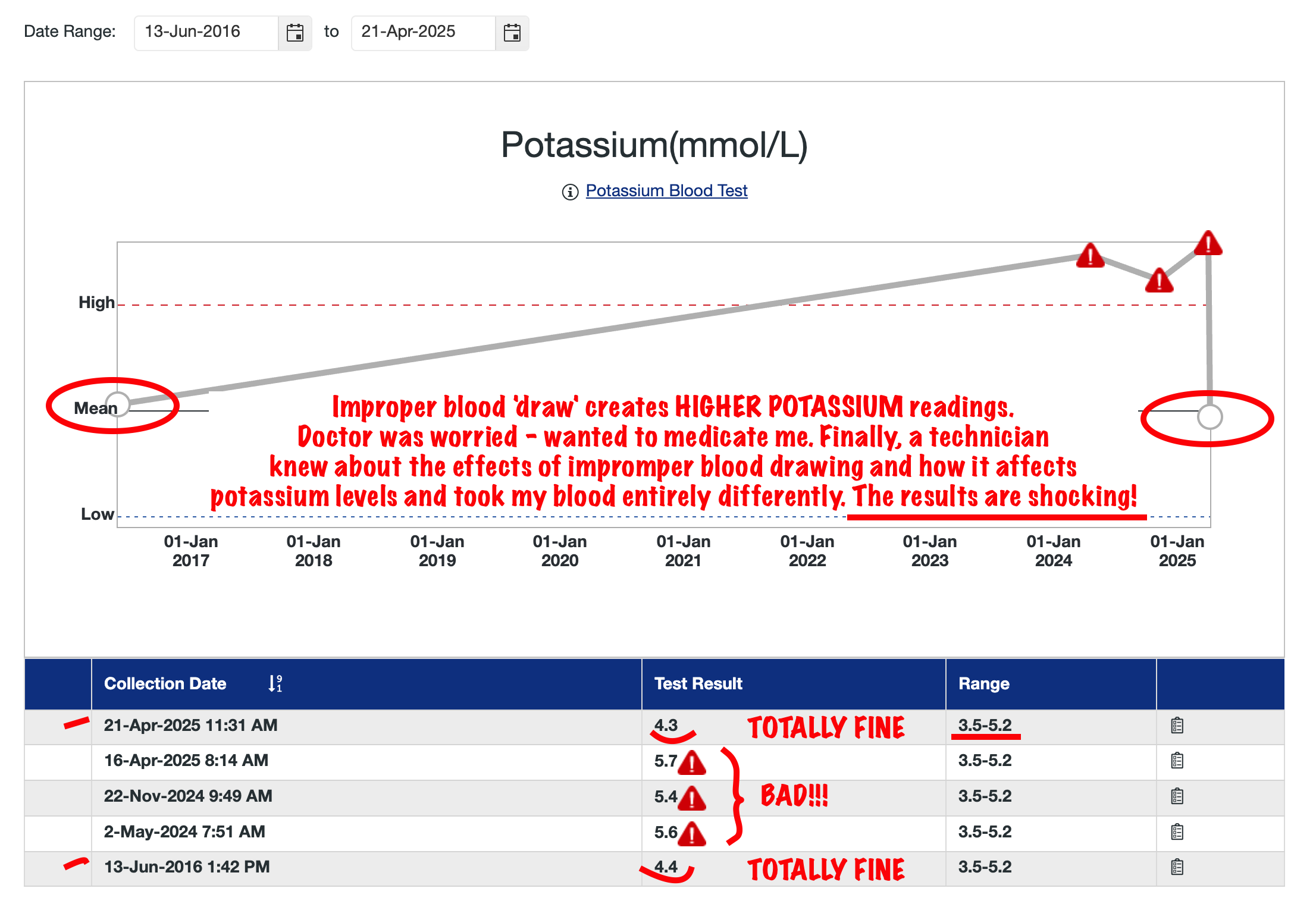
Three consecutive tests in less than a year all came back flagged:
- May 2024: 5.6 mmol/L
- November 2024: 5.4 mmol/L
- April 2025 (8:14 AM): 5.7 mmol/L
The normal range? 3.5 to 5.2 mmol/L.
I was told this was “mild hyperkalemia”–and while mild, it was persistent. My doctor wanted to act.
But something didn’t sit right.
One Technician, One Observation, Everything Changed
Before I agreed to start taking anything, I asked for one more test. This time, a technician did something very different. They asked detailed questions about how my blood had been drawn in the past. Then they took the sample without a tourniquet, didn’t ask me to clench my fist, and made sure the sample went straight to the lab.
Result from that same week (April 21, 2025, 11:31 AM):
4.3 mmol/L. Totally normal.
Cue shock.
What Happened?
The answer is something called pseudohyperkalemia. It’s not a disease–it’s a false alarm. Potassium levels appear elevated in the lab, but it’s not a true reflection of what’s happening inside your body. And it’s usually caused by:
- Improper tourniquet use
- Clenching or pumping your fist during the draw
- Hemolysis (when red blood cells rupture during handling)
- Delayed processing of the sample
Any of these factors can lead to a misleadingly high potassium reading.
Why This Matters (To You)
The normal repeat result gave my clinician an important new piece of evidence and made collection technique worth investigating. It did not, by itself, prove that every earlier result was false. True hyperkalemia can be dangerous, and the safe response depends on the complete clinical picture.
The Takeaway: It’s Not Just the Numbers
Lab values are tools that need clinical context. When a result is unexpected, it is reasonable to ask how the sample was collected and whether confirmation is appropriate—without assuming the result is wrong.
So if your lab results ever show something off, ask:
- How was the sample taken?
- Could collection technique have impacted the results?
- Would confirmation or a different collection protocol be appropriate in my case?
In my case, collection and handling became a plausible explanation that my clinician could evaluate. That is a better conclusion than either blindly accepting or casually dismissing the number.
Clinical background: Errors in Potassium Measurement: A Laboratory Perspective for the Clinician.
#StayFrosty!